
Art
Mission Statement
At Dorchester Learning Centre, our aim is to ensure every student feels safe, supported and ready to learn. Within art, we focus on building positive relationships and making creative activities accessible to all. This helps our students develop confidence, engage with learning and make meaningful progress. We also enter students for appropriate qualifications to open pathways to future education, training and employment.
Intent
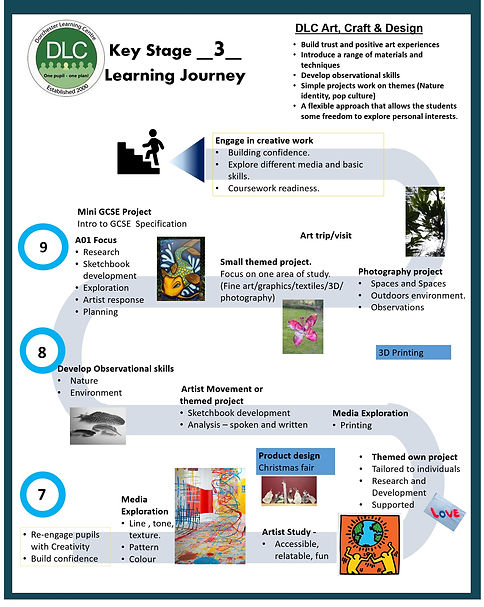
Our curriculum aims to equip learners with the skills, knowledge, and visual literacy needed to explore a wide range of materials and creative processes. We foster a safe, supportive environment where students are encouraged to experiment, take creative risks, and develop confidence in their ideas. Through engaging and purposeful learning experiences, we want every learner to experience success and understand the value of creativity both within school and beyond.
Through our curriculum we aim to:
Develop learners’ skills, knowledge, and understanding of a wide range of materials, techniques, and artistic processes.
Build visual literacy, enabling students to analyse, interpret, and respond to artworks, images, and the world around them.
Encourage creative risk-taking and experimentation within a safe and supportive learning environment.
Support students in discovering and developing their individual artistic voice.
Promote confidence, resilience, and pride in the creative process as well as the final outcome.
Ensure all learners experience success and make meaningful progress, regardless of their starting point.
Enable students to recognise the relevance and value of creativity in everyday life and future pathways.

Careers in Art, Craft and Design
We actively support students in developing the eight essential employability skills: listening, speaking, problem solving, creativity, staying positive, aiming high, leadership, and teamwork.
Careers education is embedded through:
Personalised projects linked to student interests and career pathways (e.g. 3D printing for product design, colour theory and pattern cutting for fashion, Bloxels for game design).
Working to briefs, particularly within graphic design, to develop real-world creative problem-solving skills.
Enterprise opportunities, such as mini product design fairs, linking creativity to business and life skills.
Encounters with professionals, including visiting artists and gallery visits, broadening cultural capital and industry awareness.
Public outcomes, including an end-of-year exhibition where students present their work to an audience.
Live briefs, enabling students to respond to real clients and authentic creative contexts.
Assessment in Art, Craft and Design
Assessment is structured, continuous, and aligned with the AQA assessment framework. Student progress is tracked through portfolios and recorded on SIMS.
Students are supported to demonstrate the four assessment objectives:
AO1: Develop ideas through investigation, demonstrating critical understanding of sources.
AO2: Refine work through exploration and selection of appropriate media, materials, techniques, and processes.
AO3: Record ideas, observations, and insights relevant to intentions as work develops.
AO4: Present a personal, meaningful response that realises intentions and demonstrates understanding of visual language.
Assessment is strengthened through:
Clear written feedback and targets that identify strengths and next steps.
Regular verbal feedback during lessons to guide progress in real time.
Opportunities for self-assessment and reflection, encouraging students to take ownership of their learning.
Baseline assessment through initial projects to inform planning and differentiation.
We aim for all students to complete at least one AQA Art GCSE by the end of Year 11, ensuring they leave with both a recognised qualification and a strong portfolio of creative work.